












































Types of Forks and Knives: A Complete Guide to Dining Cutlery & When to Use Each
A complete cutlery set at home can often feel like a riddle to solve. A large fork and a curved one. A knife with serrations on the side and another that isn't sharp at all. Where do they go, and how are they used? These are questions that many people wonder about.
Knowing your cutlery thoroughly is not limited to understanding its use. It also comes in handy at a formal table when you are trying to figure out which piece goes first and which one comes when. Why do they look so similar yet serve entirely different purposes?
We have curated a dining cutlery guide to make it easier for you to understand how to use each piece separately and what purpose each one serves.
Types of Forks — Dinner, Salad, Dessert and Fish

The fork family consists of several members, and each one has a significant role to play. Though they may look similar, they differ in length and tine design and serve different purposes. Let’s explore the various types of forks and uncover the distinct functions behind each.
Dinner Fork: It is the largest and heaviest fork among the lot and is meant for main course. Its length and long tines make it suitable for meat and dense vegetables. It can be identified by its four long, equal tines.
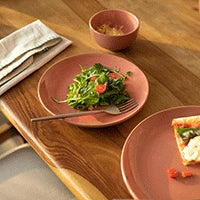
Salad Fork: Glance at the neat rank of forks on your dinner table and pick the one that is short, wide, flat and sometimes notched in shape. This is the one you start with. It is shorter than the dinner fork but is wider, flatter and sometimes notched in shape. These attributes make it perfect for cutting through lettuce and crisp vegetables. Its broad tines also help with softer ingredients.
Dessert Fork: The length of this fork is similar to that of a salad fork. It has thin and delicate tines crafted for cakes, pastries and soft fruits.
Fish Fork: This fork is almost the same size as a salad fork. It has wide, curved tines that make it easier to get under the skin of the fish, separate it from the flesh and lift it away from the bones smoothly.
In conclusion, the fork you pick depends on the food on your plate.
Types of Dining Knives — Dinner, Butter and Steak
Similar to forks, knives also come in different shapes and forms. Hence, their functions and purposes vary accordingly. Here is a closer look at each of them below.
Dinner Knife: It is the longest knife among the lot and features a long, rounded tip with a slightly curved blade. It is often considered an all-purpose workhorse because it is designed to cut through cooked vegetables as well as soft proteins such as chicken or fish. The absence of aggressive serrations also makes it convenient to handle during meals.
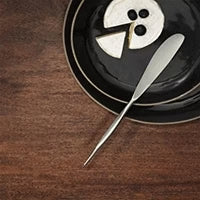
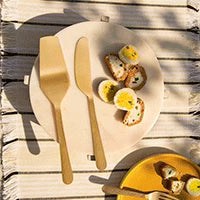
Butter Knife: It is small in size and slightly blunt, with a wide shape and a flat blade. These features make it suitable for scooping butter, cheese or jam and spreading them evenly across a surface.
Steak Knife: It is the sharpest among the group and has a pointed tip, an aggressively serrated edge and a heavier, ergonomic handle to offer a better grip while cutting through dense, fibrous meats, including beef, steak, pork chops and venison.
How to Remember Which Fork or Knife to Use

Even though you are aware of all the knives and forks and their functions, it can still become overwhelming at the dining table when you see the cutlery lined up and barely have time to count the tines or inspect the edge of each knife. Allow us to get you out of this maze.
To make it as simple as possible, follow the "outside-in" rule. It is also known as the golden rule of cutlery etiquette. Since the meal starts with appetisers and salads, use the forks and knives placed at the outermost edges. As the main course begins, you will naturally move towards the larger utensils placed next to the plate.
Another way to remember cutlery placement is through the FORKS acronym. Read it from left to right. 'F' stands for forks on the left, 'O' represents the round plate, 'R' denotes the right side of the plate, 'K' stands for knives placed on the right immediately next to the plate, and 'S' represents spoons placed to the right of the knives.
Last but not least, if you ever find cutlery placed at the top of the plate, do not panic. It is reserved for the final act. These are your dessert spoons or forks and are kept separate so that you can enjoy the sweet treats at the end.
Indian Dining Context — When Do We Use Cutlery?
Traditional Indian dining is designed around eating food with hands. There is minimal use of cutlery other than serving food from serveware to plates. Eating with hands is preferred in many Indian households because it allows people to experience the temperature, texture and variety of dishes that are an integral part of Indian cuisine.
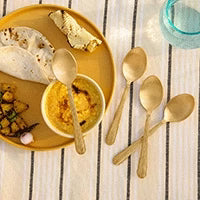
However, the influence of Western culture and British rule introduced the use of cutlery in Indian dining as well. Even so, it is largely limited to spoons and forks since a regular Indian thali consists of rice, gravies and curries that pair well with dinner spoons.
When eating an Indian meal, a fork can be used as a pusher. Hold it in the left hand and gently push rice, meat or vegetables onto the spoon held in the right hand.
The meat in Indian cuisine is usually cooked until tender, allowing it to fall easily off the bone. This leaves little need for specialised cutlery such as steak knives or fish forks.
When enjoying an Indian meal, flatbreads such as roti, naan, chapati, puri and dosa are best eaten with your hands. Kebabs, chicken wings and chops are also easier to enjoy this way. On the other hand, if you are having Chinese or Pan-Asian food, which is often served in India, you can make effective use of cutlery. This also applies to steaks, sizzlers, pasta and pizza. At formal corporate events where meals are served in a Western-style manner, one can always follow the "outside-in" rule mentioned above.
How to Care for Your Cutlery
Whether it is your regular cutlery or a set that has been inherited from your forefathers, the two factors that can cause severe damage are scratches and chemical corrosion.
Cutlery sets made of stainless steel can also experience damage, such as tiny spots, rust spots or white-water marks, if not maintained carefully. Some practices that can keep your favourite cutlery set looking as good as new are as follows:
Try to rinse your cutlery immediately, as leftover food may contain acidic ingredients such as tomato sauce, lemon juice, salad dressing or salt that can corrode metal overnight. A quick rinse under tap water can save it from further damage.
Do not leave cutlery soaking in harsh detergents. Prolonged contact with strong dishwashing detergents can diminish the sparkle of the utensils.
After washing, let the cutlery dry on a drying towel or wipe it with a lint-free cloth to prevent water marks.
Once completely dry, store the pieces in a drawer or organiser. Refrain from overcrowding them so that the pieces do not rub against one another and cause scratches.
If your cutlery is made of brass or copper, clean it only with material-specific cleansers.
Shop ellementry Cutlery Sets
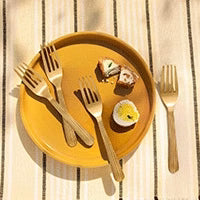
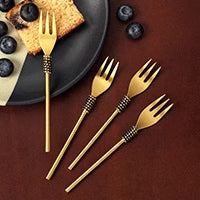
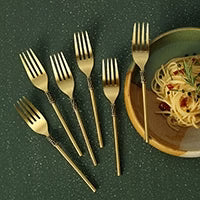
Ellementry's cutlery sets are handcrafted with new-age Indian cuisine in mind, blending form and function effortlessly. The Celestial Brass Fruit Fork Set of 4 carries a golden metallic sheen that looks perfect in a contemporary kitchen setting.
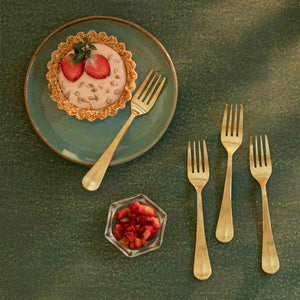
On a similar note, the Dinner Fork Set of Four with a champagne gold finish can also elevate your dining experience.
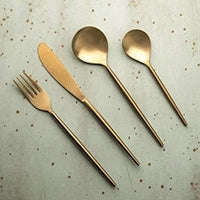
A rare find, the Enigma Rose Gold Cutlery Set of Four and the Aura Gold Cutlery Set of Four, available in rose gold and golden shades respectively, include all the essential utensils one may need, including a dinner spoon, knife, fork and dessert spoon.
FAQs
What are the different types of forks and what are they used for?
Common types include dinner forks for main courses, salad forks for appetisers, dessert forks for sweets, and serving forks for dishing out food.
What is the difference between a dinner knife and a butter knife?
A dinner knife is used for cutting and eating food, while a butter knife has a blunt edge designed for spreading butter, jams, and soft spreads.
How many types of forks are there in a formal place setting?
A formal place setting typically includes three forks: a salad fork, a dinner fork, and a dessert fork.
Which fork do you use first at a dinner table?
Start with the fork placed farthest from your plate and work your way inward with each course.
What cutlery should I buy for everyday Indian dining?
A practical set includes dinner spoons, teaspoons, dinner forks, and dinner knives made from durable, easy-to-maintain stainless steel.

 easy returns
 safe & secure
 hand crafted